

- Mobile site
- E-Newsletters
-
- News feed
- Find us on Twitter
@Essex_Echo
Follow us
- Find us on Facebook
Echo
Like us on Facebook
Venomous spider discovered on Canvey (From Echo)
Get involved: send your pictures, video, news and views by texting ECHONEWS to 80360, or email us »
Venomous spider discovered on Canvey
8:00am Wednesday 28th November 2012 in Castle Point
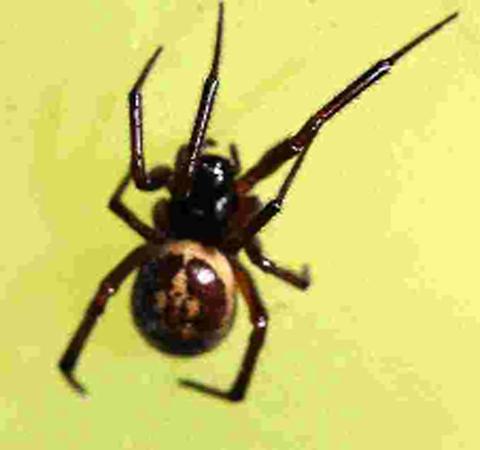
THE most dangerous species of spider in the UK is weaving its web on Canvey.
Mum-of-one Tori Cass-Heales, 30, has so far found about six False Widow spiders both inside and outside her home in Third Avenue.
When she first caught site of one in her bathroom she said it stopped her in her tracks and because it was so big she decided to investigate further.
“I was a little bit shocked and concerned,” she said.
“I’m not scared of spiders or anything like that, I’m a bit of a boff and if I don’t know what something is I like to know so I got in touch with a spider identification website.”
Mrs Cass-Heales posted her discovery on social networking sites such as Facebook and said it generated “a lot of interest”, although it did worry some of her friends.
She has a two-year-old daughter and her partner also reacts badly to insect bites so she is now humanely getting rid of the spiders when she sees them as she said she cannot risk any member of her family getting hurt.
The venomous arachnid, which is a close relative of the deadly black widow spider, has the most poisonous bite of any spider in the UK.
However, it only tends to attack when it is provoked and it is the female that delivers the potentially fatal bite.
Mrs Cass-Heales added: “The lady I e-mailed said they have been here for a long time, but it’s not common knowledge so I’d like to raise about the threat they can pose.
“All this time I have taught my daughter she does not need to be scared of creepy crawlies, but you do. Things like that look like a warning, we all know bees can kill people and we know not to touch them and the same applies to these spiders.”
Steve Falk is an entomoloist at Buglife, the invetebrate conservation trust.
He said: “We’ve had a lot of enquiries about them at Buglife. They have started to colonise in the south of Britain and are spreading north.
“Most spiders in the house are not that dangerous, but if you see one and know it’s definitely a False Widow then you can just suck it up the hoover to get rid of them.
“I personally wouldn’t want them in my house, particularly if I had children.”

Comments are closed on this article.
Comments (18)
8:14am Wed 28 Nov 12
EastStBoy says...
From Wikipedia:
Steatoda (False Black Widows) are significantly less harmful to humans.... bites by Steatoda species generally do not have any long-lasting effects
So I take from this that the UK's "most deadly" spider is in fact not deadly at all.
Good work, Echo. Good work.
8:27am Wed 28 Nov 12
Russ13 says...
http://www.telegraph
.co.uk/news/newstopi
cs/howaboutthat/9210
860/Woman-nearly-los
t-arm-after-black-wi
dow-spider-bite.html
This real life example would suggest that they are more poisonous than the tripe you found on Wikipedia.
8:34am Wed 28 Nov 12
Olivia2847 says...
9:35am Wed 28 Nov 12
mikepaterson says...
Adult spiders are capable of biting humans. Spiders are not aggressive and most injuries to humans are defensive bites delivered when a spider becomes unintentionally squeezed or pinched.
Steatoda nobilis
Steatoda nobilis the false widow spider will only bite defensively when under attack.
The bite of the false widow spider can be medically significant in humans, but usually without any long-lasting effects.
Reports from those bitten describe a certain amount of pain, which often radiates along the limb or part of the body where bitten, and often a degree of swelling in the affected part. Some describe fever and a general feeling of being unwell. These symptoms may last for a couple of days but the total effect is unlikely to be more serious than that.
As for bites from other species in the genus Steatoda, it can produce a set of symptoms known as steatodism.
More serious symptoms have occasionally been reported, but are likely to be the exceptional reaction of individuals to the venom. It is always advisable to seek medical attention if symptoms persist.
So not really a massive danger to people.
10:21am Wed 28 Nov 12
Eric Whim says...
1:08pm Wed 28 Nov 12
ccd says...
4:08pm Wed 28 Nov 12
r6keith says...
8:27pm Wed 28 Nov 12
EastStBoy says...
My point was regarding the article showing "most deadly" in the title and throughout the piece. You may find it disappointing that the Echo has found this to be a little OTT and has amended the references of "deadly" to "venomous"
I will let you go back to your coin collecting and train spotting, factboy.
9:14am Thu 29 Nov 12
Mr. Pedantic says...
These, quite prolific, spiders can't be that dangerous otherwise there'd have been a lot of such news stories over many years. How many more have you seen?
I suspect Russ13 is scared of all creepy crawlies, snakes and spiders. He probably has to keep the light on at night, in case the Bogieman comes to get him too.
10:15am Thu 29 Nov 12
Warriorisme says...
The false widow, along with other UK spiders will generally only cause a reaction if you are allergic or get an infection!
You have just as much chance of an allergic reaction to a bee.
10:16am Thu 29 Nov 12
Warriorisme says...
10:37am Thu 29 Nov 12
minesabud says...
11:20am Thu 29 Nov 12
Eric Whim says...
;-)
1:20pm Thu 29 Nov 12
rjsizzler says...
"...it is the female that delivers the potentially fatal bite."
Which appears to be completely wrong unless you consider other bites/stings such as those delivered by bees as 'potentially fatal' due to possible allergic reactions.
4:35pm Thu 29 Nov 12
bazza 1 says...
10:21pm Fri 30 Nov 12
Markmyword says...
12:38pm Mon 3 Dec 12
Antonius says...
Never let the facts get in the way of a good headline
3:52pm Mon 3 Dec 12
Tone-Fu says...
Now we'll have loads of cretins stamping on every spider they see.
As someone else ably pointed out, these little things are no more a risk to people than wasps - sure, people can have a bad reaction, but its not something that happens often.